
Focused In: What Our New Strategic Plan Means for the Future of Equitable EMS in California
By Tanir Ami, CEO
Over the past year, our team — together with our board, grantees, community leaders, and partners from across California's EMS ecosystem — dug into some big, important questions that shaped our Strategic Plan.
What does this field need most from CARESTAR right now?
What kind of impact do we want to have?
And what will it take to look back years from now and say, with honesty, that we changed something meaningful?
And today, I'm sharing where these powerful questions led us.
Why a New Strategic Plan, and Why Now
Since our founding, CARESTAR Foundation has worked intentionally alongside researchers, EMS leaders, and communities to understand the inequities that shape emergency medical care in California.
We've watched the field grow more sophisticated in documenting disparities, including who receives care, how quickly it arrives, what protocols get applied, and what outcomes follow.
What we know for sure is that documentation matters. But the field is ready for more. The next challenge, and the bigger opportunity, is translating what we know into real, measurable change.
That's what our 2026–2030 Strategic Plan is designed to do.
Our Future Focus as a Data-Driven Racial Equity Leader
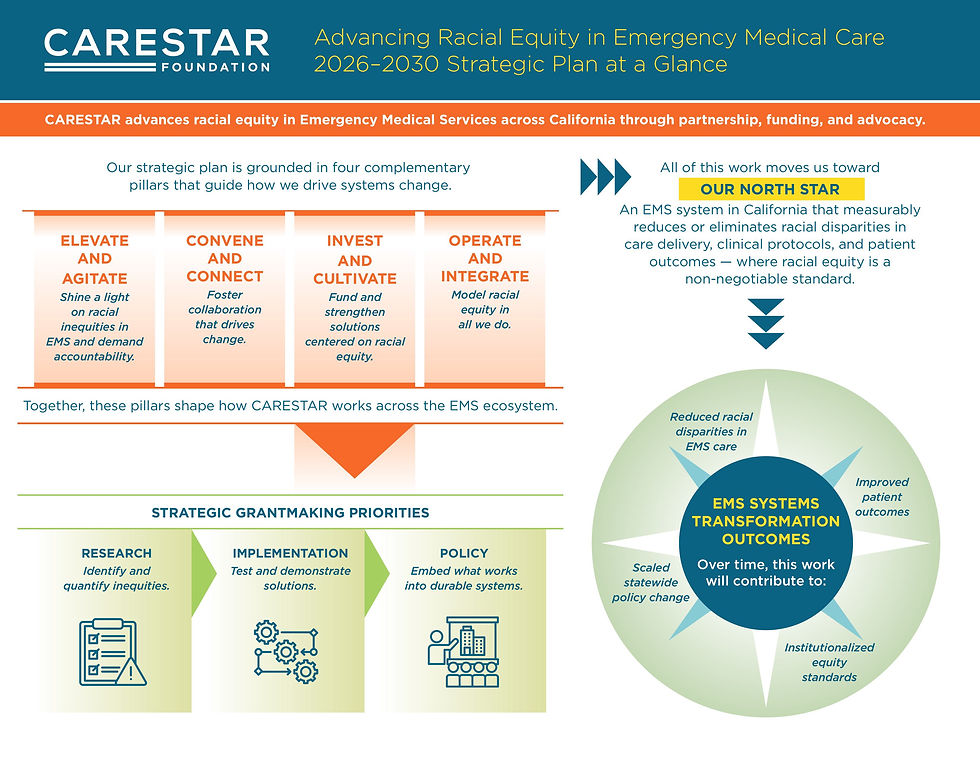
We spent a lot of time figuring out how to describe what we're becoming. The phrase that captures it best: Data-Driven Racial Equity Leader. That phrase is both a description and a commitment. It means we'll lead initiatives grounded in rigorous data and lived community experience. It means we'll push beyond awareness toward accountability. And it means we'll hold ourselves to the same equity standard we're asking of the field. Our North Star reflects this: to advance an EMS system in California that truly serves all Californians — where racial equity is not aspirational, but standard practice.
Four Pillars, One Direction
The plan organizes our work into four focus areas, each playing a distinct role in strengthening the EMS system and improving care.
Elevate and Agitate. We'll raise awareness around racial inequities in EMS — using data to shine a light on disparities and putting that knowledge to work.
Convene and Connect. This work doesn't happen in isolation. We'll continue to bring people together, including EMS agencies, public health systems, hospitals, community organizations, policymakers, and researchers, to align around racial equity as a shared non-negotiable.
Invest and Cultivate. Philanthropy can be a catalyst, and that's the role we intend to play. Our grantmaking will focus on initiatives that test solutions, generate evidence, and demonstrate what it actually takes to improve outcomes and close the equity gap. We'll make more focused, strategic investments in areas where we believe we can drive the most measurable change.
Operate and Integrate. Equity is embedded in our vision, our mission, and our operations. That means ensuring our values are present in our own decision-making, partnerships, communications, and governance — and we intend to hold ourselves accountable to the same standards we're asking of our state’s healthcare systems.
A Community-Driven Plan
No single foundation — in fact, no single organization of any kind — can transform a system on its own. The changes we're seeking require collaboration at every level: between EMS agencies and community organizations, between researchers and practitioners, between policymakers and the people most affected by the policies they write.
We've been fortunate to learn from many of you. Our partners have been at this work for years, sometimes decades, longer than CARESTAR has existed. Your experience, your data, and your willingness to challenge the status quo have shaped this plan in ways we're genuinely grateful for.
We're not stepping back from this work. We're focusing in, with more clarity, more intention, and more opportunities for collaboration along the way.
Together, we can achieve measurable improvements in patient clinical outcomes within communities that have historically been underserved. Together, we can evolve the EMS system into one where data, community insight, and collaborative leadership move in the same direction. And together, we can make racial equity no longer an aspiration in California emergency care, but the baseline.
That's the future we're working toward. And we're glad to be working toward it with you.


Comments